LoanBook
Primary Loan Syndication
A permissioned workspace for primary loan syndication, coordinating arrangers, lenders and borrowers across deal setup, controlled information distribution, bookrunning, allocation and closing.
- Company
- NewBridge Fintech
- Role
- VP, Product
- Location
- Dubai, UAE
- Timeline
- Apr 2025 to Jul 2026
Product overview
The Primary Syndication Lifecycle
The arranger coordinates the facility end to end. Lenders enter at launch, the borrower returns at closing.
01
Deal Setup
02
Deal Site Preparation
03
Launch and Onboarding
04
Bookrunning
05
Commitment and Allocation
06
Deal Closing
07
Agency Handover
Mandates the arranger
Signs the Facility Agreement
LoanBook coordinates the deal across every stage
Enter at launch, progress through the book, participate at closing
Terminal transition into Agency
Operating context
Why Syndication Is Operationally Complex
Not one approval flow. Many institutions, many users inside each, and a book that has to stay current between launch and closing.
Legacy systems
Deal information lived in email, spreadsheets and shared drives.
Multi-institution coordination
Arrangers, lenders, borrower and Agent, each with several users.
One syndicated deal
Invitations, access, status, allocation
Lender
Lender
Lender
Lender
300+ lender organisations, each with participating users
Investor lead management
Hundreds of prospective lenders, each at a different point in review.
Information control
MNPI and NDA obligations decide what each participant may see.
Governance and permissions
Access, actions and allocations need an attributable record.
Product teardown
Inside the LoanBook Workflow
Four connected workflows move a deal from configuration to a closed book. Select one to see it in depth.
Principal arranger workspace
Bookrunning
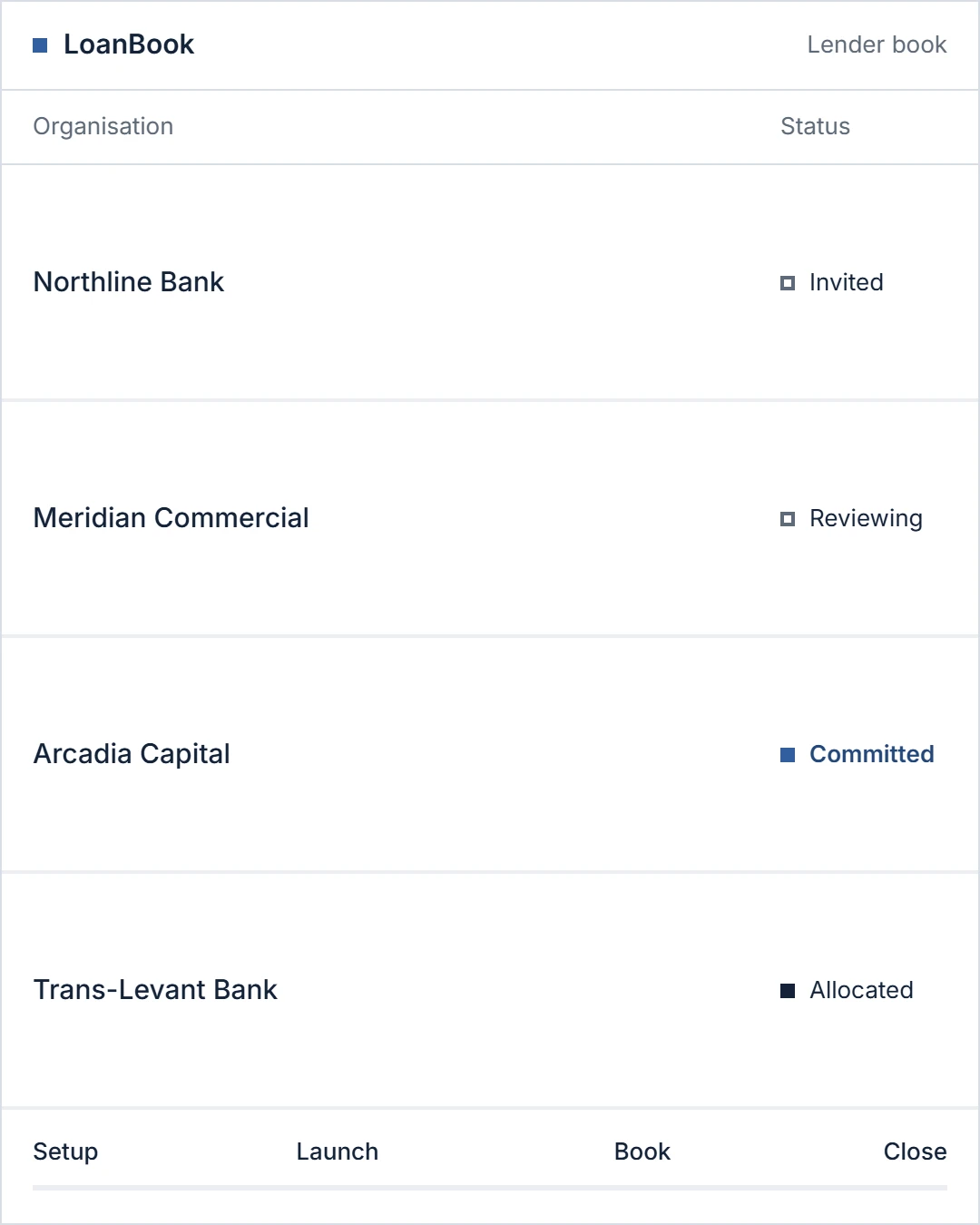
Building and managing the lender book. Every linked organisation, its users, arranger coverage and current status in one view. Institutions participate as organisations, individuals drive the progression.
Organisation and user hierarchy with a covering arranger
Seven participation states, decline as a defined override
Notes, commitment letters and actions on behalf
Grouping by status or arranger across a large book
Recorded by arranger on behalf
Call with Head of Syndications. Commitment received offline. Note classified as private.
Organisation status logic
The organisation takes the most advanced status held by any of its users. Decline overrides.
Acting on behalf
The covering arranger records offline activity, amounts and letters, with attribution retained.
Commitment against allocation
Allocation is a separate decision, so a lender can commit 200M and be allocated 100M.
Platform systems
Systems Across the Deal Lifecycle
Four systems span every workflow rather than sitting between stages.
Notification System
Arrangers can see whether a deal communication actually reached its recipient, and resend or reuse its content.
Product decisions
Rules That Govern Participation, Access and Allocation
The consequential decisions were rules, not screens. Open one to read its situation, rule, rationale and trade-off.
Situation
Not every prospective lender should receive every document at the same point in syndication.
Product rule
Documents are assigned to persona and investor-status groups, with Read, watermarked PDF and Original as distinct rights.
Rationale
Information can be released progressively as the lender moves through review, interest and commitment.
Trade-off
Layered permissions are powerful but require clear precedence, inheritance and exception behaviour.
Permission model, four information levels
Folder permissions are inherited by files, so the level is set once and applied consistently.
Product outcomes
Institutional Adoption and Product Reach
Mashreq Bank and Emirates NBD
Institutional users of the platform.
300+ lender institutions
Onboarded as organisations, not a count of individual users.
Middle East, North Africa and India
The institutional reach represented on the platform.
The product established one controlled path from deal configuration through lender onboarding, document distribution, bookrunning, commitment, allocation and closing.
Role and scope
From Solution Design to Delivery
Product solutioning and design
Modelled deal, tranche, organisation, user and participation-state relationships, and converted institutional rules into permissions, gates and status transitions.
Arranger discovery and feedback
Worked with arrangers on how deals are launched, covered and closed, reconciling offline relationship activity with a controlled platform record.
Delivery ownership
Converted workflows into prioritised requirements, coordinated implementation and reviewed behaviour across connected workflows as the product went live.
Continue to LoanBook Agency
Follow the facility beyond primary closing into Agency onboarding, obligations, cashflows and ongoing loan servicing.